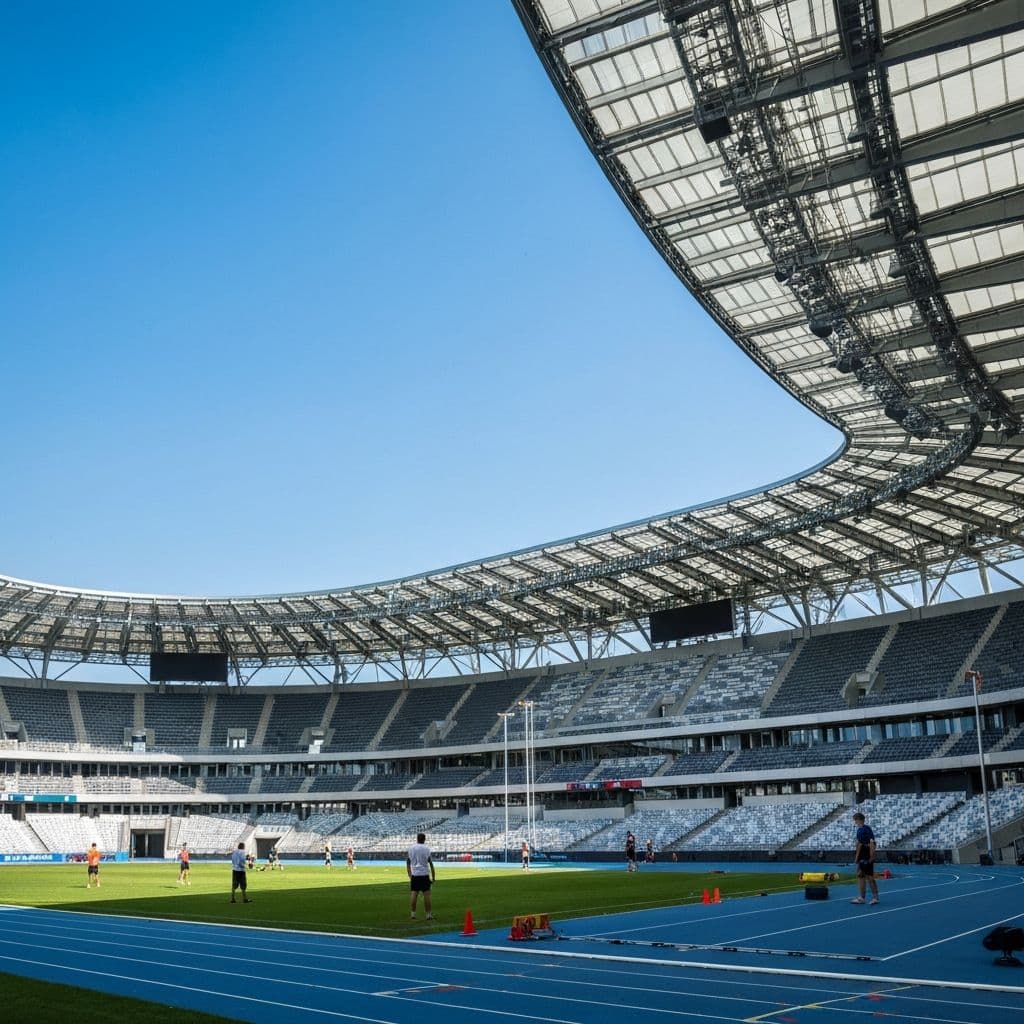
The Immovable Deadline
Most capital projects have flexible completion dates. If a commercial office building finishes three months late, the owner absorbs carrying costs and renegotiates lease commencements. If a warehouse delivery slips by a quarter, the logistics adjustment is manageable. The financial consequences are real but recoverable.
Sports and entertainment venues operate under a fundamentally different constraint. The opening date is not set by the construction schedule — it is set by forces entirely outside the project team's control. A professional sports league determines when the season begins. A touring concert series has routing commitments that cannot shift by weeks. A performing arts company has subscribers who purchased tickets for a specific date in a specific hall. A major public event — a championship, a festival, a cultural milestone — has a date that was set years before construction began.
This is the defining characteristic of venue delivery risk: the deadline exists independently of the project. It does not care about supply chain disruptions, design changes, permitting delays, or weather events. It simply exists, and everything else must conform to it.
Owners planning sports and entertainment venue projects need to understand this dynamic from the earliest planning stages — not because it is unfamiliar in concept, but because its implications for project governance, risk management, and delivery strategy are profound and often underestimated.
Why Venue Opening Dates Are Different
The Calendar Is Not Negotiable
In conventional construction, a missed deadline triggers a conversation. The owner, contractor, and design team discuss the causes, assess the remedies, and negotiate a revised schedule. There may be liquidated damages, but the fundamental assumption is that the project will be completed when conditions allow.
Venue projects eliminate this assumption. A professional sports franchise cannot tell a league that the stadium will not be ready for opening day. A performing arts organization cannot tell 15,000 subscribers that the season will start somewhere else. A convention center cannot tell the trade show that booked three years ago that the exhibit hall is not quite finished.
The consequences of missing these dates extend far beyond the project itself:
- Revenue loss that cannot be recovered. Missed events represent revenue that is permanently lost — not deferred. A missed home opener is not replayed. A canceled concert date is not rescheduled at the same venue months later.
- Contractual cascades. League agreements, broadcast contracts, sponsorship deals, and booking commitments all reference specific dates and specific facilities. Missing a delivery date can trigger penalty clauses across multiple contracts simultaneously.
- Reputational damage with lasting effects. Public venues are public investments — politically, financially, and emotionally. A missed opening date becomes a news story, a political liability, and a narrative that follows the project for years.
- Operational displacement costs. If the venue is not ready, events must go somewhere. Temporary arrangements — alternative venues, reduced capacities, makeshift operations — carry their own costs and create their own complications.
The Parallel to Cultural Institutions
This dynamic is not unique to sports venues. Cultural institutions face the same pressure when planning exhibition openings tied to loan agreements with international museums, anniversary celebrations that cannot shift, or festival dates that anchor an entire community calendar. Performing arts centers face it when a resident company has sold a season of subscriptions in a hall that is still under construction.
The shared lesson from both sectors is clear: hard-date projects require a fundamentally different risk management posture than projects with flexible timelines. The risk management approach that works for a speculative office building — identify risks, manage them as they arise, adjust the schedule as needed — is inadequate for a project where the schedule cannot adjust.
The Categories of Delivery Risk
Understanding what threatens a venue opening date requires looking beyond construction-phase risks to the full delivery lifecycle. The risks that actually cause missed opening dates are rarely single dramatic events. They are cascading sequences that begin months or years before construction is complete.
Regulatory and Permitting Risk
Permitting risk is among the most underestimated threats to venue delivery. Large public assembly venues require approvals that extend well beyond standard building permits:
- Special use permits and zoning approvals that may involve public hearings, community input processes, and political review cycles that are inherently unpredictable
- Environmental review and impact assessments that can introduce requirements — noise mitigation, traffic management, stormwater treatment — not anticipated during design
- Fire marshal and life safety reviews for high-occupancy assembly spaces, which impose requirements that are more stringent and more heavily scrutinized than standard commercial construction
- Accessibility compliance reviews that evaluate not just code minimums but functional accessibility for large-scale public events
- Health department and food service permits for venues with concession operations, which introduce an entirely separate regulatory track
Each of these approval processes has its own timeline, its own review authority, and its own potential for delay. The risk is compounded by the fact that many of these approvals are sequential — one cannot proceed until another is complete — and by the reality that review authorities are not accountable to the project schedule.
The mitigation strategy is early engagement. Owners who wait until design is substantially complete to begin regulatory conversations discover too late that assumptions embedded in the design are not aligned with regulatory expectations. Design & Regulatory Management as a structured discipline — not just a compliance checklist — is essential for venue projects where permitting delays can directly threaten the opening date.
Procurement and Supply Chain Risk
Venue projects depend on long-lead procurement items that have limited substitution options. Specialized seating systems, large-format video displays, acoustic treatment materials, custom structural steel, and specialty MEP equipment all have procurement timelines that can exceed twelve months from order to installation.
The risks in this category include:
- Single-source dependencies for proprietary systems — particularly audio-visual, scoreboard, and broadcast infrastructure — where alternative suppliers cannot provide compatible products
- International sourcing vulnerabilities for materials and equipment that are manufactured in limited global locations
- Fabrication capacity constraints for custom elements — specialty steel, architectural metalwork, custom glazing — that require dedicated production capacity
- Shipping and logistics complications for oversized or heavy components that require specialized transportation and rigging
Procurement risk management for venue projects requires a procurement strategy that identifies critical-path items early, establishes procurement timelines that align with (or precede) the design schedule, and builds contractual protections — performance bonds, liquidated damages for late delivery, pre-negotiated alternatives — into supplier agreements.
Weather and Site Condition Risk
Weather risk in venue construction is amplified by several factors that do not apply to typical commercial projects:
- Large structural spans — arena roofs, stadium canopies, retractable roof systems — require extended periods of favorable weather for erection and are highly sensitive to wind conditions
- Exterior enclosure at scale — the sheer volume of exterior envelope work means that weather-sensitive activities occupy a larger share of the schedule than in conventional buildings
- Site work and infrastructure — venues typically require extensive site development — parking structures, utility infrastructure, access roads, public plazas — that is highly weather-dependent and must be substantially complete before the venue can open
- Geographic and seasonal constraints — many venue projects are located in climates with limited construction seasons, compressing weather-sensitive work into narrow windows
Weather risk cannot be eliminated, but it can be managed through schedule structure. Building adequate weather contingency into the baseline schedule — not as aspirational float, but as structured time allocated to specific weather-sensitive activities — is a fundamental risk management discipline. Projects that show zero weather days in their construction schedule are not optimistic; they are unrealistic.
Technology Integration Risk
Modern venues are among the most technology-intensive buildings constructed today. The integration of audio-visual systems, distributed antenna systems (DAS), Wi-Fi networks, point-of-sale infrastructure, digital signage, access control, security cameras, building management systems, and broadcast infrastructure creates a web of interdependencies that is uniquely vulnerable to integration failures.
The technology integration risks that threaten opening dates include:
- Late specification of technology systems, which compresses procurement and installation timelines
- Interface conflicts between systems from different vendors that were not identified during design
- Commissioning failures that emerge only when systems are tested together under operational conditions
- Bandwidth and infrastructure inadequacy discovered during load testing
- Software configuration and customization that requires more time than anticipated
Technology integration risk is discussed in greater depth in our analysis of coordinating technology, security, and guest experience in modern venues. The essential point for opening-date risk management is that technology systems must be treated as critical-path delivery items from the earliest planning stages — not as late-stage overlays that will somehow work themselves out.
Commissioning and Operational Readiness Risk
The gap between construction completion and operational readiness is one of the least understood risks in venue delivery. A venue can be substantially complete — all major construction finished, all systems installed — and still be weeks or months away from being ready to host an event.
Commissioning — the systematic process of testing and verifying that all building systems perform as designed — is inherently time-consuming for complex venues. It requires:
- Individual system testing for every mechanical, electrical, plumbing, fire protection, and technology system
- Integrated system testing to verify that systems work together as intended — that the HVAC system does not create noise that interferes with the sound system, that the lighting control system interfaces correctly with the event management platform, that the fire alarm system properly integrates with access control
- Load testing under conditions that simulate actual event operations — full-capacity crowd simulations, simultaneous system operation, peak electrical and data loads
- Operational training for the venue's operations staff, who must be proficient with all building systems before the first event
Beyond commissioning, operational readiness includes furniture, fixtures, and equipment (FF&E) installation; signage and wayfinding; concession equipment and inventory; merchandise operations; and the thousand details that transform a constructed building into a functioning venue.
Projects that treat commissioning and operational readiness as afterthoughts — activities that will happen in the final weeks before opening — are projects that miss opening dates. The mitigation is to plan commissioning as a structured phase with its own schedule, its own resources, and its own contingency.
Proactive Risk Management vs. Reactive Problem-Solving
The Fundamental Distinction
Most project teams practice reactive risk management. They identify problems as they arise, develop solutions, and adjust the schedule and budget to accommodate. This approach can work for projects with flexible timelines — there is always more time to solve problems.
For venue projects with immovable opening dates, reactive risk management is structurally inadequate. By the time a risk manifests as a problem, the time available to solve it has already been consumed. The schedule compression required to recover lost time introduces new risks — overtime fatigue, quality shortcuts, concurrent work in spaces that should be sequenced — that compound the original problem.
Proactive risk management operates on a fundamentally different timeline. It identifies risks before they become problems, develops mitigation strategies before they are needed, and monitors leading indicators that signal emerging threats before they reach the critical path.
Building a Risk Visibility Framework
Effective proactive risk management for venue projects requires structured risk visibility — the ability to see emerging threats early enough to act on them. A practical risk visibility framework includes:
Risk Register with Probability and Impact Assessment A living document that catalogs identified risks, assesses their probability of occurrence and potential impact on the opening date, assigns ownership for monitoring and mitigation, and is reviewed and updated at regular intervals. The risk register is not a compliance document filed and forgotten — it is an active management tool.
Leading Indicator Monitoring Rather than waiting for risks to manifest, leading indicators provide early warning:
- Permit application status and review timelines — tracking not just whether permits have been submitted, but how review is progressing and whether timelines are consistent with the project schedule
- Procurement milestone tracking — monitoring shop drawing approvals, fabrication progress, and shipping schedules for long-lead items against required delivery dates
- Design completion metrics — tracking the percentage of design documents that are complete, coordinated, and approved at each milestone, with variance analysis against the plan
- Labor availability indicators — monitoring trade labor availability in the local market and identifying potential shortfalls before they affect production
- Weather pattern tracking — monitoring seasonal weather data and comparing actual conditions against the weather contingency built into the schedule
Decision Velocity Tracking One of the most reliable predictors of schedule performance is the speed at which decisions are made. When owner decisions, design clarifications, or change order approvals begin to lag, the project is accumulating schedule risk that may not appear in the construction schedule for weeks or months. Tracking the backlog of pending decisions and the average time to resolution provides an early warning of governance-related schedule risk.
Schedule Health Analysis Beyond tracking whether the project is "on schedule," proactive risk management evaluates schedule health — the quality and reliability of the schedule itself. This includes:
- Critical path analysis — understanding which activities actually drive the completion date and monitoring their progress with special attention
- Float consumption tracking — monitoring how quickly schedule float is being consumed and whether the rate of consumption is sustainable
- Logic integrity verification — confirming that the schedule logic accurately reflects actual construction sequence and dependencies
- Resource loading validation — verifying that the schedule is achievable with the labor and equipment resources actually available
The Role of Owner-Side Oversight
Proactive risk management cannot be delegated entirely to the construction team. The contractor manages construction risk from the contractor's perspective — which is legitimate and necessary, but not sufficient. The contractor's risk perspective is shaped by the contractor's contractual obligations, financial incentives, and operational priorities, which may not fully align with the owner's interest in opening-date certainty.
Contract Administration & Risk Management as an independent owner-side function provides the perspective and the authority to manage opening-date risk from the owner's point of view. This includes holding the contractor accountable for schedule performance, but it also includes managing the risks that originate on the owner's side — decision-making delays, scope changes, stakeholder-driven interruptions — that the contractor cannot control but that threaten the opening date just as surely as construction-phase problems.
The Financial Consequences of Missed Opening Dates
Understanding the financial exposure associated with a missed opening date is essential for calibrating the investment in risk management. Owners who view risk management as an overhead cost rather than a financial protection strategy often underinvest — and the consequences can be severe.
Direct Revenue Loss
For a professional sports venue, each missed home event represents lost revenue across multiple streams: ticket sales, premium seating, concessions, merchandise, parking, and sponsorship activation. For a major arena, a single missed event can represent several hundred thousand to several million dollars in direct revenue loss. A missed season opener — or worse, a missed opening stretch of events — can represent eight-figure exposure.
For entertainment and leisure venues, the calculation is similar. A concert hall that misses its grand opening season loses not just ticket revenue but the marketing momentum and critical attention that accompanies a new venue launch. That momentum, once lost, is difficult to recapture.
Indirect and Consequential Costs
Beyond direct revenue loss, missed opening dates generate cascading financial consequences:
- Temporary facility costs for relocating events to alternative venues, often at premium rates and with reduced capacity
- Contractual penalties under league agreements, broadcast contracts, and naming rights deals that reference specific facility availability dates
- Extended financing costs — carrying construction loans and development costs beyond the planned capitalization period
- Extended general conditions — the contractor's ongoing site presence, supervision, equipment, and overhead costs during the delay period
- Acceleration costs if the decision is made to compress the remaining schedule through overtime, additional crews, or out-of-sequence work
- Legal and dispute costs if the delay triggers claims among project participants
The Risk Management Investment Calculation
When the financial exposure from a missed opening date is quantified — often in the tens of millions for major venues — the investment in proactive risk management becomes straightforward to justify. A structured risk management program that costs a fraction of the delay exposure and reduces the probability of a missed opening date by even a modest percentage represents a compelling return on investment.
The challenge is that this investment must be made early — during planning and pre-construction — when the opening date feels distant and the pressure to manage costs favors cutting "soft" services. Owners who defer risk management investment until problems emerge have already lost the window in which proactive management is most effective.
Practical Steps for Opening-Date Protection
For owners in the early stages of planning a venue project, several practical steps can materially reduce opening-date risk:
Start with the opening date and work backward. The construction schedule should be derived from the required completion date, not the other way around. This means establishing the opening date, backing out commissioning time, backing out construction duration, and determining when design must be complete and when pre-construction activities must begin. If the resulting timeline is not feasible, the scope or the approach must adjust — not the opening date.
Invest in pre-construction planning. Every week invested in thorough pre-construction planning — programming validation, design coordination, procurement strategy, permitting engagement, risk identification — reduces risk during the construction phase when recovery options are limited. Front-loading planning is the single most effective opening-date protection strategy.
Establish governance that supports decision velocity. Venue projects generate hundreds of decisions that affect the schedule. The governance framework must ensure that decisions are made at the right level, by the right people, within timeframes that support the construction schedule. Slow decision-making is one of the most common and most preventable causes of schedule delay.
Engage independent owner-side oversight early. Construction Management & Quality Control provides the structured oversight — schedule monitoring, risk tracking, quality assurance, and issue resolution — that keeps the project aligned with the opening date throughout the delivery process. This oversight is most effective when engaged before construction begins, during the planning and pre-construction phases when the risk management framework is established.
Build structured contingency into the schedule and budget. Contingency is not optimism — it is a planned reserve for known unknowns. Schedule contingency should be allocated to specific risk categories (weather, permitting, commissioning) rather than held as undifferentiated float. Budget contingency should be sufficient to fund acceleration measures if schedule contingency is consumed.
Plan commissioning and operational readiness as a distinct phase. Do not assume that commissioning will happen in the final weeks before opening. Plan it as a structured phase with its own schedule, milestones, and resources. Allow time for systems to fail during testing — because they will — and for those failures to be diagnosed and corrected before opening day.
The Governance Foundation
Opening-date risk in venue projects is ultimately a governance problem. The risks themselves — permitting delays, procurement problems, weather, technology integration — are technical challenges that competent project teams manage routinely on other project types. What makes these risks uniquely threatening in venue projects is the immovable deadline that eliminates the most common recovery mechanism: more time.
Managing delivery risk under an immovable deadline requires governance that is faster, more structured, and more disciplined than what most capital projects demand. It requires decision-making authority that is clear and accessible. It requires risk visibility that is continuous and honest. It requires accountability that is enforced, not assumed.
Owners who establish this governance foundation early — and maintain it throughout the project — give themselves the best possible chance of meeting the opening date that their league, their community, their audiences, and their financial commitments demand.
For owners beginning to plan a venue project with a fixed opening commitment, the risk management conversation should start now — not when construction begins. Contract Administration & Risk Management provides the framework for identifying, quantifying, and managing the delivery risks that threaten opening dates, giving owners the visibility and the decision-making structure to protect the date that matters most.